Medical Sterilizers: Air-Removal
Authored by Jonathan Carfora, Technical Services Trainer
The most adverse element to proper steam sterilization is the presence of air (non-condensable gases) inside the chamber. Chamber air can cause cold spots and limit the ability of steam to penetrate the items being sterilized. Air shields the items being sterilized from the steam inside of the chamber, preventing surgical instruments from adequately receiving the full penetration they require, and sterility assurance cannot be complete. .
A sterilizer program consists of three phases:
- Pre-treatment
- Sterilizing
- Post-treatment
While all three phases are critical for proper sterilization, the pre-treatment phase has the unique function of removing air from the sterilizer chamber. The process of removing air from the sterilizer chamber is known as conditioning.
Two methods are commonly used to condition (remove air) from the sterilizer chamber:
- Pre-vacuum (dynamic air aspiration)
- Gravitational
Pre-vacuum (PreVac) conditioning methods use a vacuum pump to suck the air out of the sterilizer chamber. The vacuum pump runs until the chamber is allowed to reach a vacuum of less than 100 mbar absolute (1.45 psi absolute), this number may vary depending on the model and manufacturer of sterilizer. Steam is then admitted into the chamber. This process is repeated multiple times to ensure the chamber is free of air.
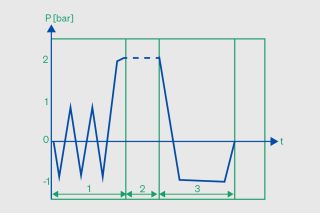
Section ‘1’ of the diagram shows the pre-treatment portion of the sterilizer cycle.
In this case, a PreVac conditioning step was performed. Notice how pressure alternatively drops and rises, forming a zig-zag pattern. This is the result of the vacuum pump running (pressure drop) followed by steam being admitted to the chamber (pressure rise).
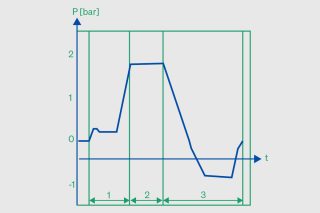
Pressure-time diagram Gravity
Section ‘1’ of the diagram shows the pre-treatment portion of the sterilizer cycle.
Steam is admitted into the chamber while the drain is opened. This causes pressure inside of the chamber to rise. While steam is being added to the chamber air is being forced out. Gravitational (gravity) conditioning is accomplished by introducing steam into the sterilizer chamber while the drain valve is open. Since steam is lighter than air, it displaces the air towards the drain using the force of gravity. The heavier cold air is pressed out of the sterilizer chamber drain by the steam being introduced.
The PreVac method is normally the preferred conditioning method because air is more effectively removed, and less steam is consumed. Gravity conditioning is usually reserved for items that are pressure sensitive and could be damaged by a strong vacuum.
Various tests such as the Bowie-Dick, dynamic air removal test may be used to check for proper conditioning. These tests usually consist of a test pack that simulates a difficult to sterilize load. A failed test indicates that the sterilizer is not effectively removing air or may have air leaks.
Reasons why conditioning could fail:
- Overloading the sterilizer or incorrect positioning of items being sterilized.
- Door seals leaking air into the sterilizer chamber.
- Failed/faulty steam traps and orifices.
- Leaking chamber safety valves.
- Low-quality steam.
Most conditioning-related problems can be prevented by properly servicing and maintaining the sterilizer. Routine servicing includes the replacement of wear parts such as seals and gaskets that may contribute to air leaks.
Leak tests should also be run at least once a week. These tests allow for the early detection of air leaks and allow for their repair before they become a bigger issue.
Key Takeaways
- Air is the number one enemy of proper sterilization. Its presence will shield the instruments from the steam in the chamber, preventing them from being properly sterilized.
- The conditioning process is a critical part of a sterilizer program and is responsible for the removal of air from the sterilizer chamber.
- A failed air-removal test such as a Bowie-dick test normally indicates excessive air in the sterilizer chamber.
- Routine servicing plays a key part in maintaining the sterilizer chamber air-free.
- Leak tests should be performed weekly.
To learn more about sterilization check out our Clinical Classroom “Sterilization & Distribution” CE Article Program, worth continuous education credit. Access is free and easy to use.