Ultrasonic Washers: Cavitation
Authored by Jonathan Carfora, Technical Services Trainer
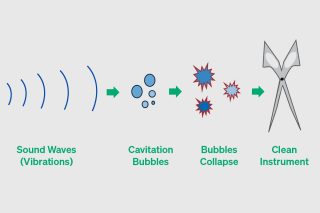
Ultrasonic cleaning has become a common method of cleaning in a variety of industries. A common misconception is that it is the sound waves themselves that cause the cleaning action. Instead, sound waves are used to cause a phenomenon called cavitation. This phenomenon provides powerful scrubbing action observed in an ultrasonic washer.
Cavitation is the formation of small cavities, or microbubbles, by high frequency sound waves. These bubbles rapidly expand and contract due to the sound waves passing over them. Eventually the microbubbles collapse, releasing powerful shock waves. The shockwaves easily penetrate the small openings and crevices found on medical instruments, resulting in a cleaning action.
Factors that influence the intensity of ultrasonic cavitation:
- Temperature – Cavitation generally increases in intensity as the temperature increases, until a peak performance temperature is reached.
- Nature of the Liquid – Water allows for better cavitation than most other organic solvents.
- Surface Tension – Liquids with high surface tension deliver more cavitational energy than low surface tension solutions.
- Viscosity – Higher viscosity liquids are harder to cavitate.
- Vapor Pressure – Liquids with high vapor pressure at room temperature are more difficult to cavitate.
- Hydrostatic Pressure – Reducing hydrostatic pressure makes liquid easier to cavitate.
- Dissolved Gasses – The more dissolved gasses in solution the harder it is to cavitate.
- Time – The longer a liquid is exposed to ultrasound the better the results.
Ways to maximize cavitation inside an ultrasonic washer:
- Degassing – The process of removing trapped air from a solution.
Trapped air reduces the effectiveness of ultrasonic cleaning. Before running a cycle, it is important to allow time for the tank to completely degas. Degassing is normally achieved by running the ultrasonic washer for additional time at the start of its cycle. This extra runtime allows the dissolved gases to leave the ultrasonic bath, increasing cavitation. Degassing only needs to be performed once per fill. If the water is reused in the next cycle, it does not need to be degassed again. - Chemistry – Using the right detergent can increase the effectiveness of ultrasonic cleaning. It is generally best to use the lowest concentration provided by the manufacturer for instructions for use (IFU). When selecting a chemistry, be sure to choose one with the following qualities:
- Supports cavitation.
- Free rinsing; does not leave a residue.
- Non-foaming, or low foaming
- Compatible with the types of soils being removed.
- Compatible with the types of metals and materials being cleaned.
- Temperature – The most effective range for Belimed ultrasonic washers is between 105°F – 140°F. Temperature specifications may also be listed on the detergents IFU.
- Maintenance – An ultrasonic washer must be in good working condition to maximize its cleaning potential. Some units, including Belimed ultrasonic washers, require the generators to be tuned periodically. Tuning the sonic generators ensures the device will output the maximum level of cavitation energy resulting in faster and more effective wash cycles.
Key Takeaways
- A detergent type plays a vital role in how ultrasonics operate. Always make sure the solution being used is low/non-foaming, compatible with ultrasonic use, and free rinsing to avoid any leftover residue.
- Too much detergent can impact ultrasonic performance. Always follow the manufacturer’s guidelines.
- Degassing is critical for proper cavitation. This is normally accomplished by increasing the run time of the first cycle for each new batch of water.
- Regular maintenance is critical for efficient operation of an ultrasonic. The generators must be checked for proper tuning at least annually. Failure to do this could lead to longer and less effective cleaning cycles.
To learn more about our Ultrasonic cleaning systems click here: Ultrasonic Cleaning Systems